How To… Run an Ad on Facebook

Facebook

Have you noticed that your newsfeed on Facebook is almost always full of paid ads by companies? Well, there’s a reason for that!

Because of changes to Facebook’s algorithms throughout the last few years, businesses found that their organic reach declined. Companies were sending out the same content but basically just shouting out into the wilderness. Savvy businesses soon sussed out that paying for ads on this platform gets them the reach they want.

If you have never run an ad on Facebook before, or perhaps it didn’t work for you the first time round, this is the blog for you. Let’s get into this…
1. Get Targeting

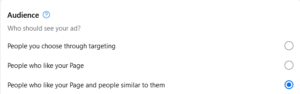
There are almost 3 billion Facebook users who use the platform daily. That’s a lot of people, but you’re obviously not going to reach all of them! I personally find Facebook’s ad creation really straightforward. The platform allows you to really hone in on who precisely you want to target. Here are some of the ways you can target your ads on Facebook:

– Location – local, or further afield, you’ll be given the option
– Custom Audience – you can specify age, interests, location, key words, education. Targetting people in the local area, people who like your page and similar to them. The possibilities are endless.

2. What do you want your ad to achieve?

It’s vitally important that you have in your mind what you want your ad to achieve. Would you like more visitors to your website, more messages, calls, page likes, leads? You can select your goal when setting up your ad. Alternatively, Facebook can select a goal for you automatically.

Taking a picture for Facebook3. Looking Good

Having great images on your ad will help big time. Facebook will automatically select the last few pictures that you’ve taken, but you can choose which ones you’d like to have displayed. It’s a great way of really showing off what you have to offer so choose wisely (you can have up to 5 images).

If you don’t want to go down the picture route, then choose a video. Customers are 1.81 x more likely to make a purchase after viewing a video compared to an image ad. There isn’t really a time limit of how long your video should be (you can use the full 240 minutes, but I wouldn’t advise it!). Videos in ads that are up to 30 seconds long will get you the best result.

Take a look at some of these great Facebook Ads here for inspiration.

Top Tip: Bit stuck on how to make a video? Try Canva for free. I’m in this app pretty much my whole working day. There are so many templates and videos you can choose in here, it will truly revolutionise your social media pages.

4. How long and how much?

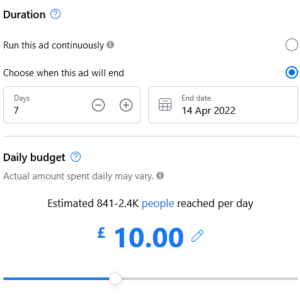
Schedule a start date and time, and when you’d like to ad to finish.

As to when is the best time to get the ad out there, it varies. It all depends if you’re B2B or B2C. If you’re targetting the former, run your ads during the week, the latter, during Friday’s and the weekend. Most people are on Facebook at midday, so start your ad then.

The Daily Budget for your Facebook ad depends on how many people you’re looking to target (and of course what your business has set aside for social media). The higher the budget, the more people you’ll reach.

Once you’ve done all of the above, hit that Promote Now button!

5. The Do’s and Don’ts

There are the do’s and don’ts when it comes to creating an ad for Facebook.

– Don’t write lots of text – this will definitely switch people off
– Don’t be deceptive – not only will this annoy customers, it could get you banned from the platform
– Do proof read before you hit that promote button – check that spelling!
– Know your audience – this is key. This will help you target the right people, and also set the ‘voice’ to the ad.
– A clear call-to-action – Facebook will ask what button you want to go onto your ad (i.e. Get Messages, Call Now, Find Out More, etc.) but also put this in your text.
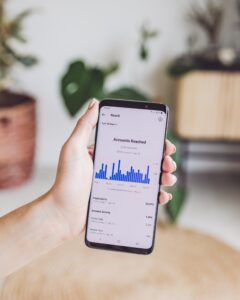
Facebook Insights6. How did it measure up?

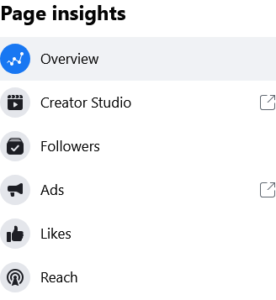
To find out how successful your ad was, focus on the following metrics under Insights:

– Actions
– Cost per Action
– Spend
– Frequency
– Revenue

Don’t focus on these “vanity” metrics:

– Click Through Rate (CTR)
– Clicks
– Cost per 1,000 impressions
– Reach
– Impressions

Whilst these figures look great, Actions and Revenue is showing you exactly what you’ve made from the ad.

There you have it, some tips on getting a succesful ad on Facebook!

To keep up to all the latest news at Function28 and best practice tips, take a look at our blogs or find us on social media.



The world’s most expensive vanity project or the protection of free speech?

TwitterOk, so things have calmed down enough for us to take stock about what the heck happened to Twitter last week!

On Monday 25th April, news broke that Twitter’s board of directors had accepted Elon Musk’s offer of $44 BILLION for control of the social media platform. The South African has apparently acquired Twitter to make sure the platform adheres more closely to the principles of free speech.

The board at Twitter at first resisted Musk’s offer, taking the ‘Poison Pill’ defence to shield themselves from a hostile takeover just days before they accepted his offer.

What has been the reaction to this, and why has Elon Musk bought Twitter? Let’s delve in…

The Reaction

Musk’s takeover of Twitter was met with a mixture of shock, fear, and humour by Twitter employee’s. The fact that Twitter is now protecting its source code from potential disgruntled employees kind of says it all. Remember when an employee on their last day closed down Donald Trump’s account? That’s one way to leave your job…

A number of celebrities have left Twitter because of the Musk takeover. They cite various reasons, namely because of opinions he’s shared on the platform ranging from politics to the use of pronouns.

There are those who don’t see the takover as a bad thing. Even the former CEO of Twitter, Jack Dorsey tweeted his support of Musk and his plans to transform it.

According to a recent poll, 58% of marketers aren’t worried. Musk has said that he will eliminate harmful bots by verifying accounts. Marketers like myself are happy that the Edit button might actually be on the horizon now.

Many express they are happy about the potential changes to the platform when it comes Musk’s campaign on free speech. Some think will help broaden the audience.

This leads us nicely on to the next topic of this takeover…

Free Speech

“Free speech is the bedrock of a functioning democracy, and Twitter is the digital town square where matters vital to the future of humanity are debated,”
Elon Musk

The other 42% of marketers from this poll are worried for about the future of Twitter. With Musk’s crusade on free speech (he describes himself as a “free speech absolutist”), some worry that the platform will be flooded with dubious consipiracy theorists and ‘alternative truthers’. They are concerned that the billionaire will “turn a blind eye to harassment, hate speech, disinformation and other vile expressions”. Potentially, this could turn off many big brands who no longer will want to be associated with Twitter.
Some people on the Right see Twitter as being more left-leaning compared to other platforms (this research shows otherwise), as a number of big names on the Right have been banned from Twitter, including a former president of the United States.  Maybe Trump et al will make a comeback now Musk is in charge?

Musk is well-known for blocking “haters” on Twitter when they tweet negative opinions about him, so how can this person really be for free speech?

Some journalists and business owners think it’s not about free speech at all. So what is it all for?

Other factors at play

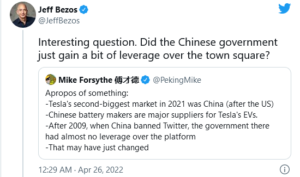
Amazon founder, and second richest man in the world, Jeff Bezos shared his opinion on Twitter about Musk’s buyout:-

Could China now have an influence on Twitter now that Elon Musk has bought it? It’s certainly an interesting take on the whole thing and one that could absolutely lead this author down a rabbit hole! But I won’t get into this today…

I’ve seen a few jokes on Twitter about this being one of the most expensive mid-life crisis ever. It could well be, but of course, this isn’t the first big company that Musk has splurged out on.

We’ve also got to think about the actual character of the man. A word that is often bandied about is, ‘Narcissist’. Has Musk come to the conclusion that money can really buy you love? Searching through Twitter comments about this subject (aka, the cesspit), you will inevitably come across Elon Musk ‘Fanboys’ who idolise the man as some sort of saviour of the “Deplorables”. All the Likes, Retweets, Replies and Follows are just fuel to Musk. Why not buy a platform that makes him feel like King of the World?

The Future

My initial reaction to the news was, “another rich man spending money on things that he shoudn’t be”, followed by “hmm, it could work, Tesla is doing ok! Hey, an Edit button!” to, “I’ve got a really icky feeling about this”.

I’m on the side of the 42%. I worry about what this white, billionaire, middle-aged man can do to the future of free speech on social media.

The last thing we need right now is for someone of privilege to start polarizing the world even further by allowing the floodgates to open on hate speech, misogyny, and racism.

We’ve all seen what impact Rupert Murdoch has had on the world by purchasing multiple media outlets. I don’t see this as any different, Musk is now effectively a modern-day media tycoon with this purchase. We don’t need another Murdoch, that’s for sure.

Hey, I could be completely wrong and Musk will throw away his toy and move on to something new, and maybe help solve climate change with his billions…

To keep up to date with all the latest goings on in the digital world, please give us a follow on Facebook, Twitter, Instagram and LinkedIn.

Read our other blogs here.


#OverIt – is the hashtag dead?

Hashtags first came into prominence 15 years ago with businesses finding them a great way to organise content and reach more people.

However, in the last few years, spam and bot accounts have hijacked hashtags, adding them to their posts that have no relevance to the subject, meaning anyone searching for that hashtag has numerous posts displayed in front of them that don’t make any sense.

A number of marketers believe that hashtags just don’t have the power they once had. Recently, even the Head of Instagram said they are pretty much a waste of time.

This begs the question, is the hashtag dead?

Many marketers still advocate the use of hashtags, as they have proof directly from the analytics showing they result in engagement.

Here at Function28, we don’t believe the hashtag is dead, you just need to use them wisely. Let’s get into this…

How many is too many?

Instagram has a 30 hashtag limit. You can by all means use all 30, but after 10 or so, they get diluted and too far away from the actual content.  Our advice is to use 7-10, this way you stay on subject.

Do your research

Before you post, find out what hashtags are used commonly within your industry. There are fancy-pants paid for sites (such as this one) that can help you with this, but all it takes is a little bit of your time. Search within Instagram keywords for your industry, e.g. #SocialMediaMarketing, and see how many posts there are with that hashtag. The rule is, if the hashtag has over 1m posts, stay away from using that one. Your post will only get lost in that feed and bring you very little in the way of followers or engagement.

Monitor what the competition is doing. What hashtags do they use? What posts worked best for them?


Keep it relevant

Whatever hashtags you do use, keep them relevant to the content you’re posting. There are some rules that you should always have in mind when you’re using hashtags:-

Description – for example, for a post advertising web design, use the hashtag, #webdesign

Location – if you’re posting about an event, maybe where you’re based, put in the location

Keep it short – too many words make it harder for people to read, and the likelihood of it being a popular one in the first place is very low.


Show your support

You’ll see many companies using hashtags as a way of promoting/supporting social issues, for example #IWD2022 was widely used amongst a variety of companies back in March for International Women’s Day. If there is a way of linking a trending social issue’s hashtag for your company and you want to show support, then this is a good way of getting you in front of a wider audience.

Is the hashtag dead? Nope! Keep using them but wisely, and you’ll see your engagement grow!

Want to keep up to date with all the latest marketing and social media advice? Follow us on Facebook, Twitter, Instagram, and LinkedIn.

Read our other blogs here.


How to… Facebook for Business

Are you not sure what to write on your business Facebook page? It’s significantly different to posting on your personal profile and can sometimes leave people stumped!

Here at Function28, we want every company, big or small, to succeed in promoting their company on various social media platforms. We’ve put together a handy guide on what you should be doing on Facebook for your business.

1. Profile Picture
Let’s start with the very basics. On many occasions in my travels, have I seen companies NOT using their logo as their profile picture. If you would like customers and new followers to find you easily, use your logo or relavent imagery. When it comes to your Cover Photo, make it engaging. For example, if you have some professional photos of what your company can create, showcase them here.

2. Choose the right buttons
When you create your Facebook business page, you’ll be asked what Call-to-Action button you’d like to be featured at the top of your page. Think to yourself, what action would you like your customers to take? Would you like them to message you, call you, or visit your website?

3. About You
AboutWhen creating your Facebook Business profile, you should be filling in the About section. This area will tell potential followers more about what you do and they’ll get a feel for the page before they Like it.

4. Find your voice
When speaking to an acquaintance a few months ago, she was looking for social media help for her own business – I gave her one rule, “just be yourself!”. As a company, you will have a ‘voice’ that you’d like to get across to your followers. A lot of companies take a relaxed tone to their social media posts, it really of course, depends on your type of business.

Have an enthusiastic tone to your posts – no one wants to read something where the author doesn’t really care!

5. Content
Facebook is a great way to engage customers and followers using great content. You’re building your brand and talking to your customers directly, finding out what makes them tick and why they love your brand.

Your content should be 80% entertaining, engaging, and informative. 20% is reserved to talking about your product. People don’t want to have products shoved in their faces 24/7 on Facebook. You don’t want to be losing followers!

Posting your text with images is a must on Facebook. Your followers are more likely to retain the information in your post if there is an image to go alongside it.

Mix up your content with amusing gifs, quizzes, and competitions. Ask your customers questions. Followers love to get involved in conversations, and like it even more when you reply directly to them.

Make sure you know about all the holidays and event days. You can jump onto the relevent topics on these dates and engage more people – you can find a great calendar here.

6. Research
All businesses look at their competition to see what they are up to. When it comes to social media, what are their weaknesses/strong points. What would you do differently? What would you ‘borrow’?

Insights7. Post at the right times (and not too many times)
This does depend on your type of business but the general concesus is to post on early Friday morning, and Tuesday, between 6-9am. As time goes on and you post more, Facebook Insights is a really handy tool to know when most of your followers are online.  You’ll be able to find out when it’s a good time to post in order to get the best engagement.

When it comes to frequency, my rule of thumb is 3 days a week. Too little, less engagement, too much… well, less engagement!

8. C2A
All your posts should have a Call-to-Action. What would you like your followers to do? Go to your website, post in the comments, send you a message? Don’t leave them hanging!


9. Promote Your Page
When you first create your page, a great way of growing your page organically is to invite your friends and family to Like and Share the page. But if you’d like to reach out to a bigger audience, a paid ad is the route to go down.

AdYou can either promote a specific post, or promote your whole page with the view of gaining more followers, there are pletny of objectives you can choose from.

You can set your budget, timeframe, and audience type in the Facebook Ads section. It doesn’t take long to do at all.

10. Share News and Hot Topics
Brands on all platforms went to town over the hoo-ha at the Oscars this year! Jumping on to the latest news and hot topics will get you in front of more people and could gain you more followers. Ask what your followers think about the topic you’re posting about to get that engagement.


There you have it! 10 tips on how to use Facebook for your business.If you’d like a more in-depth conversation about social media, and how it can work for your business, please phone Gemma on 01884 308091, or drop her an email on gemma@function28.co.uk.

View our others blogs here.