 Ok, so things have calmed down enough for us to take stock about what the heck happened to Twitter last week!
On Monday 25th April, news broke that Twitter’s board of directors had accepted Elon Musk’s offer of $44 BILLION for control of the social media platform. The South African has apparently acquired Twitter to make sure the platform adheres more closely to the principles of free speech.
The board at Twitter at first resisted Musk’s offer, taking the ‘Poison Pill’ defence to shield themselves from a hostile takeover just days before they accepted his offer.
What has been the reaction to this, and why has Elon Musk bought Twitter? Let’s delve in…
The Reaction
Musk’s takeover of Twitter was met with a mixture of shock, fear, and humour by Twitter employee’s. The fact that Twitter is now protecting its source code from potential disgruntled employees kind of says it all. Remember when an employee on their last day closed down Donald Trump’s account? That’s one way to leave your job…
A number of celebrities have left Twitter because of the Musk takeover. They cite various reasons, namely because of opinions he’s shared on the platform ranging from politics to the use of pronouns.
There are those who don’t see the takover as a bad thing. Even the former CEO of Twitter, Jack Dorsey tweeted his support of Musk and his plans to transform it.
According to a recent poll, 58% of marketers aren’t worried. Musk has said that he will eliminate harmful bots by verifying accounts. Marketers like myself are happy that the Edit button might actually be on the horizon now.
Many express they are happy about the potential changes to the platform when it comes Musk’s campaign on free speech. Some think will help broaden the audience.
This leads us nicely on to the next topic of this takeover…
Free Speech
“Free speech is the bedrock of a functioning democracy, and Twitter is the digital town square where matters vital to the future of humanity are debated,”
Elon Musk
 The other 42% of marketers from this poll are worried for about the future of Twitter. With Musk’s crusade on free speech (he describes himself as a “free speech absolutist”), some worry that the platform will be flooded with dubious consipiracy theorists and ‘alternative truthers’. They are concerned that the billionaire will “turn a blind eye to harassment, hate speech, disinformation and other vile expressions”. Potentially, this could turn off many big brands who no longer will want to be associated with Twitter.
Some people on the Right see Twitter as being more left-leaning compared to other platforms (this research shows otherwise), as a number of big names on the Right have been banned from Twitter, including a former president of the United States. Maybe Trump et al will make a comeback now Musk is in charge?
Musk is well-known for blocking “haters” on Twitter when they tweet negative opinions about him, so how can this person really be for free speech?
Some journalists and business owners think it’s not about free speech at all. So what is it all for?
Other factors at play
Amazon founder, and second richest man in the world, Jeff Bezos shared his opinion on Twitter about Musk’s buyout:-
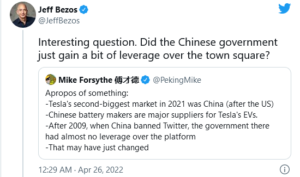
Could China now have an influence on Twitter now that Elon Musk has bought it? It’s certainly an interesting take on the whole thing and one that could absolutely lead this author down a rabbit hole! But I won’t get into this today…
 I’ve seen a few jokes on Twitter about this being one of the most expensive mid-life crisis ever. It could well be, but of course, this isn’t the first big company that Musk has splurged out on.
We’ve also got to think about the actual character of the man. A word that is often bandied about is, ‘Narcissist’. Has Musk come to the conclusion that money can really buy you love? Searching through Twitter comments about this subject (aka, the cesspit), you will inevitably come across Elon Musk ‘Fanboys’ who idolise the man as some sort of saviour of the “Deplorables”. All the Likes, Retweets, Replies and Follows are just fuel to Musk. Why not buy a platform that makes him feel like King of the World?
The Future
My initial reaction to the news was, “another rich man spending money on things that he shoudn’t be”, followed by “hmm, it could work, Tesla is doing ok! Hey, an Edit button!” to, “I’ve got a really icky feeling about this”.
I’m on the side of the 42%. I worry about what this white, billionaire, middle-aged man can do to the future of free speech on social media.
 The last thing we need right now is for someone of privilege to start polarizing the world even further by allowing the floodgates to open on hate speech, misogyny, and racism.
We’ve all seen what impact Rupert Murdoch has had on the world by purchasing multiple media outlets. I don’t see this as any different, Musk is now effectively a modern-day media tycoon with this purchase. We don’t need another Murdoch, that’s for sure.
Hey, I could be completely wrong and Musk will throw away his toy and move on to something new, and maybe help solve climate change with his billions…
To keep up to date with all the latest goings on in the digital world, please give us a follow on Facebook, Twitter, Instagram and LinkedIn.
Read our other blogs here.